Overview
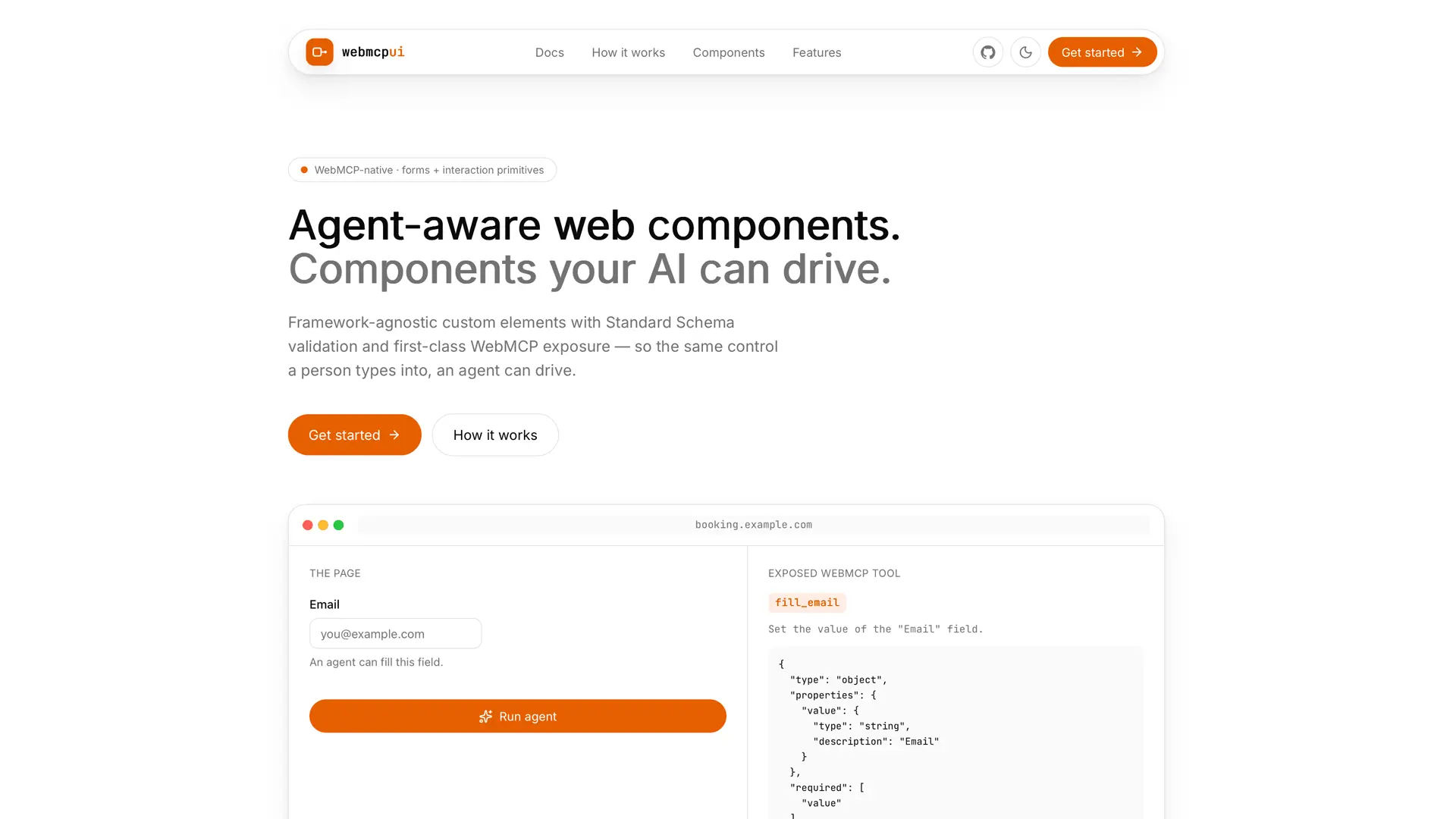
WebMCP UI is a framework-agnostic UI library built on custom elements. Every component validates its input with Standard Schema and exposes itself to AI agents through WebMCP as a first-class capability — the same control a person types into, an agent can drive.
The library ships as an open source package:
- Website: webmcpui.com
- GitHub: github.com/webmcpui/webmcpui
- NPM: @webmcpui/core
- JSR: jsr.io/@webmcpui/core
Problem
The web is gaining a second kind of user: AI agents. Most UI libraries are built exclusively for human interaction, leaving agents to scrape the DOM and guess at intent. WebMCP is a brand-new API for exposing page capabilities to agents, but building on it meant working at the bleeding edge:
- A new API with little prior art or established patterns
- A spec and standard that were still changing underneath the implementation
- Limited established guidance for connecting agent interaction with familiar interface controls
Objective
- Ship framework-agnostic components as custom elements that work in any stack
- Validate all component input with Standard Schema, for humans and agents alike
- Expose every interactive control to agents through WebMCP by default
- Keep the developer experience simple despite the moving spec
Approach
Research
Design
Development
Interaction consistency
Solution
WebMCP UI delivers:
- Custom elements that drop into any framework — or no framework at all
- Standard Schema validation on every component, shared by human and agent input
- First-class WebMCP exposure, so agents discover and drive controls without DOM scraping
- Dual publishing to NPM and JSR for broad ecosystem reach
Conclusion
WebMCP UI stakes out a position on the cutting edge of the agentic web: interfaces shouldn’t need separate APIs for people and agents. By building validation and agent exposure into the components themselves, the library makes “agent-ready” the default state of a UI, not an afterthought.